Monday, 22 May 2017
Thanks Be To Writers
I am aware that I have been neglecting this blog. Not that I expect anyone but you, Pat, to actually read it but still, the blog arose out of a desire to simply write, just for the love of it, or to offer some piece of writing that inspired me--to somehow acknowledge once a month that writing is a beautiful act, often one of healing, often one of outcry, sometimes (though I try to avoid this sort) of revenge.
I spent a number of days last week on Bowen Island, resting in the bosom of a quiet room, windows that looked out on mountains, trees, a small stretch of ocean, and even occasionally on deer. A bathtub beckoned me after walks in the woods or on the labyrinth. (One of those days--no, two--my labyrinth walks involved children bouncing along peering up to see how I'd react. It is amazing how grounded one can be in walking meditation even with all that ululation and dashing about, but even so I permitted them a small smile if they got right inside my tiny circle of attention. There is a line between focus and foolishness.)
I wrote no poems while there, though I did write a simple hymn, and worked easily on its melody a few times over the days. If having it become a brainworm is success, then, well--success!
I was very anxious when I got there. Somehow this housing thing is really eating away at me. Having the island to go to to bargain a few days of respite from my despairing brain is a real godsend. By day four I could feel actual calm beginning to surface. By day five, well, it was time to prepare to go home, and the calm evaporated in a cloud of tears. But.
Writing prevailed. Not mine, but that of others. I read a novel while I was there, but also spent time with a number of other books--Thich Nhat Hanh's How To Relax, via Overdrive (ebook through the library system), Pearl S. Buck's The Good Earth (beautiful and ugly; audiobook via Overdrive), the Autobiography of Saint Thérèse of Lisieux (this one really got me missing my gramma), and most particularly In Age Reborn, by Grace Sustained: One Woman's Journey Through Aging and Chronic Illness by Sister Thelma-Anne McLeod.
This book reached me on a number of levels, in part because the illness she suffered was Parkinson's, which killed my grandfather in the 1980s and which at the time I was too scared to learn much about. (Instead, I put my courage into getting myself to visit him when I was so afraid of losing him I was inclined to bury my head in the sand instead.) Her thoughtful examination of her physical, emotional, and spiritual struggles in response to the illness was gripping and illuminating. (Her sense of humour, humility, and pride were a delight, as well.)
I was surprised, though, by how much of her experience of chronic illness and the emotional turmoil that comes with it reflected my own. I tend to discount my illnesses and blame myself for the limitations in my life. Seeing her grapple so courageously and publicly with things I have endured for so long was a shock but also an inspiration. And some of the deeper lessons she drew from her grapplings struck me resoundingly, as well. So, the gift of grace, borrowed from others, helped me through another week.
Many thanks to the authors whose joy, sorrow, and wisdom touched me over these days.
Thursday, 20 April 2017
A Stunning Photo of (Saint Francis?)
Reminds me of him, anyway, Saint Francis. Preaching to the birds. What a gorgeous shot, Raimond. Thank you for making it available on Wikimedia.
![]() |
| Sgraffito am Haus Schadowstraße 7, Köln-Neuehrenfeld |
© Raimond Spekking / CC BY-SA 4.0 (via Wikimedia Commons)
Jenny Kwan Responds (Housing Crisis)
I posted Jenny Kwan's initial response to my letter about housing and poverty in Vancouver. I will add the links to that and to the original posting below. But I heard from her again today, and here is what she said:
Message body
Good morning Casey,
Just a quick note to follow-up on my last email to say thank you, again, for sharing your comments with me. I mentioned your email when I rose in the House recently to respond to the Liberals' very disappointing Budget 2017. Here's a link to my remarks: https://www.youtube.com/watch?v=YGGs9oYbAgQ. I relay your concerns at around the 9:55 mark in the video.
Jenny
Just a quick note to follow-up on my last email to say thank you, again, for sharing your comments with me. I mentioned your email when I rose in the House recently to respond to the Liberals' very disappointing Budget 2017. Here's a link to my remarks: https://www.youtube.com/watch?v=YGGs9oYbAgQ. I relay your concerns at around the 9:55 mark in the video.
Jenny
Original post: Housing: Guess Who Pays the Price?
First response: Housing: the Responses; the Process; the Fear
Saturday, 8 April 2017
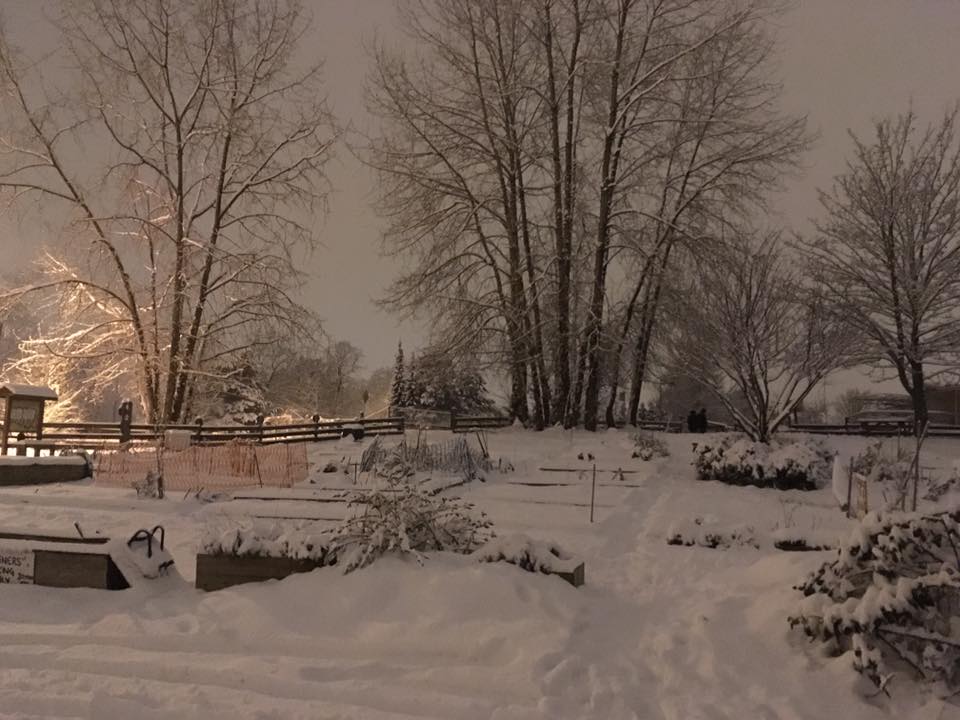
Feet in the Earth, Head in the Sky
| Still Creek Community Garden 2015 |
I lurched home, dress drenched and
sticking to my calves, groceries bundled protectively in my arms, garden
paraphenalia and leftover seeds stored soaking in my pack. Stripping at the
door, I emptied my pack on the floor, left the food where I dropped it, pegged
the pack up on my Get Kist Here! corner-grocery
door-push, hung my coat and hat to dry, and climbed into the shower to rub down
my chilled torso and my beet pink legs. When I could bear the torment of my
attentions no more (that skin is sensitive when parboiled by rain and
friction), I rubbed down, put on two long dresses, thick-knit wrist warmers, a
shawl, a cable knit sweater, and a pair of thermal socks. I couldn’t stick my
socked feet into my wooly slippers, or I would have done that, too. Two
prophylactic vitamin C tablets later, I put on the stove the last of my
homemade black bean and barley soup (featuring hunks of my winter parsnip,
still delicious and hearty despite their months under snow), and started
peeling open seed packets to dry—soaked through, most of them, despite being
kept in a ziploc bag and under an umbrella at the community garden through the
four hours I worked there today, because the hands that kept going into them
were undryable.
That done, I planted the
accidentally remaining scarlet runner beans (two) in one of my balcony pots,
threw my dress in a soapy sinkful of water to soak, washed my garden tools, set
my muddy gardening gloves and sleeve protectors aside for later attention
(triage!), cleaned the mud off my boots and left them to dry for later
application of mink oil. Peeled apart the leaves of my notebook so they
wouldn’t dry glued together, redid my sketch of the new plantings on a fresh
piece of paper, divided my groceries into that-which-is-coming-with-me-to-Bowen-Island-tomorrow
and that-which-stays-in-Vancouver-to-get-the-homefires-burning-when-I-return,
boxed, bagged and put away, and at last sat down with my bowl of hot, wonderful
soup.
I have not had so much fun in a
coon’s age.
My limbs are trembling. I keep
mistyping because my fingers are ungovernable. My back swears vengeance. My
skin threatens to peel off, dessicated from the continuous rain and being
plunged repeatedly into the earth. (There’s only so much you can do with your hands
protected. Sooner or later, if you will pardon the expression, the gloves have
got to come off.)
What did I do today to cause such
heartiness in the face of apparent discomfort?
| 2015 |
I tended my gardens. I tended our garden. I met new community garden members
and talked with old, learning more about them and loving them all.
This morning I finally got the
home garden sprinkled with organic fertilizer before dashing with Mary to StillCreek Community Garden for our first work party of the year. I got about an
hour’s work in my own beds done before the “party” started: string strung to
demarcate sections, seeds swapped with Mary, lupines inspected (I fear losses),
potatos and garlic babies planted, and I forget what-all-else before my
maintenance crew-boss Lucia arrived and we got chatting, then Clélie, bless
her, and a big hug and introductions to new folk (whose names I won’t venture
at the moment), and then the gathering up of fallen cottonwood limbs, the
weeding of communal beds, (the chatting, the chatting), the back groaning, the
back groaning, whispered love-words to horsetail and buttercup and dandelions
as I dug them up, apologies to cursing earthworms, to sadly hacked back
blackberries (though I defended them, I did, against complete removal: the
birds need them more than we don’t), and hot Tim’s coffee and Timbits (ahhh...), till at last I declared myself
done with the work party and returned to my beds.
Then it was figuring, plotting,
planting, covering, and praying. Have you ever tried to plant a garden when you
are dripping wet and the deluge continues all around you? I thanked India for
those nice big nasturtium seeds (heirloom Indian, apparently), and mourned the
frail tiny mixed lettuces, who glued to my hands in the sprinkling and were,
like the rest, unceremoniously brushed off of me and onto the earth, roughly
and lightly covered over with numb fingertips, watched by crossing eyes that
were barely able to make them out through my bifocals, and left to fend for
themselves with only a single defunct Adobe Acrobat CD turning wistfully from a
string over the kale, the leeks, the spinach, and the chard.
Those words! Delicious. My tongue
tastes them as I speak; my teeth feel their texture and their crunch.
I went nuts this year, perhaps
with increasing confidence, as I manage to harvest something every Gardener’s Question Time while unable to do more but watch my hardy
kale die mouldering in the snow and my hardier Gladiator parsnips unmoveable in
the frozen ground. (Next year, my pretties, there will be burlap around you, or
at least a little cardboard, so I can wiggle out a root or two in the Dark
Times.)
![]() |
| Katherine Laflamme, 2017. Still Creek Community Garden Facebook page |
Back to the words:
Chard.
Kale.
Parsnip.
Tomato.
Lettuce.
Leek.
Nasturtium.
Garlic.
Potato.
Spinach.
Beans.
Have you ever heard such beautiful
words in your life?
I know, then I forget, then I
remember again, that I am never happier than when I am tending a wee plant or
animal, or indeed a massive plant or animal. I don’t care what kind. There is
no weed, no pest to me, although I do sometimes have to negotiate, if you get
my drift, and urge other pastures on my associates. But I truly love them all,
and when I am able to spend time with them, joy runs through me like sap
through leaves.
A few years ago my neighbour
Darnelle urged me to join a community garden, which she had done and which was
bringing her such happiness. I thought I didn’t feel like doing that. Too much
work, too many rules, and besides, I don’t know a thing about gardening. Then
Darnelle died and I kept looking at her neglected plot and I kept thinking, I wonder.
The next year I faced cancer. I
spent a while dealing with that and where it was not a mortal blow, gras a Dye, it scared the pants off me.
After a few months of dealing with that I had the thought that I would like to
grow something more life-giving than cancer cells, so I asked for and
miraculously got a place in a community garden. I was very cautious at first,
shy of the people and shy in my planting, because I knew so little, and worried
so much.
Is it five years later now?
Something like that. And that plot, now two plots, has sustained me in many
more ways than gustatorially in that time, growing in importance every year,
roots growing out from it, through me, into the community that welcomed me, so
that the food I get from it is not only for my body, but for my soul, not only
for me as an individual, but as part of a world.
One of the first things I planted
was a purple tulip given me by my friend Kathy, who died of her own cancer
three years ago. I see today their leaves strong and their buds on the verge of
opening. (That one tulip is now two.) And they link me back to her and all we
went through, all she went through, all the people who helped, who tended our
garden of the heart along the way.
Parsnips, tulips. Marigolds, “weeds”.
The earthworms I had to dig up from other places and slowly introduce. The rain.
The cottonwoods. The peace.
It really is a community garden. And I am so grateful I have a place in it.
| 2015 |
Images: Casey Wolf and Katherine Laflamme.
Thursday, 23 March 2017
A Lovely Note
Opened my email to this. How sweet.
Dear
Casey,
I'm
going to bed with an irrepressible smile on my face,
because I've just read The
Ziz. How wonderful your stories
are. Thank you.
I
hope something's bringing you such joy.
Hugs,
Kaitlyn
This did, Kaitlyn. Thanks.
(She is of course referring to Finding Creatures & Other Stories.)
Saturday, 11 March 2017
Review: “Cathedral of the August Heat” by Pierre Clitandre
I have read more than sixty books about Haiti over the years—or
rather, nonfiction books about, novels set in, and so on. Cathedral of the August Heat * by Pierre Clitandre is the most
perplexing.
I must first say that I know little of magical realism,
which I believe is the genre this book most clearly fits into. Women become
pools, men cathedrals (well, each of those happens only once, but there is lots
else besides). This doesn't happen on every page and when it does it is
generally effective. But I can't measure its effectiveness against, say, One Hundred Years of Solitude and its
ilk, which I haven't read.
I am spending so many keystrokes on the style because this
book is much held by style, so much so that the content and indeed the story
are sometimes obscured by it. Recall that this is written in translation—as far
as I can tell, a very literate and often beautiful translation, by Bridget
Jones.
The sense I have is that some of, perhaps much of the gist
of the novel is, like the Kreyol language itself, not in the words so much as
what images and stories they remind the reader of, and in this the English
translation can't much help us. I have had times in the past when a person would
speak to me in Kreyol and I understood every word that was said and had no idea
of the meaning. English, at its most colourful, can do the same. All of this is
to explain that although I read with care, there were often times when I had
only the foggiest idea what was going on, and I don't know how much of this was
the language and how much was due to the author's tendency to switch points of
view without necessarily saying who we were switching into, and drifting back
and forth between minor characters over much of the book—occasionally lending
confusion as to whether a character was the same as another or a different one
entirely.
This may have been deliberate. We do learn names, and there
is one character in particular, strangely called John, rather than Jean, who is
more or less the main POV character. But we miss him for ages at a time and we
never really do get into his skin. Much, much is said of the collective
experience of the poor, and how they are herded back and forth and brutalized
by the elements and the soldier class. So it may be that Clitandre's vagueness
in POV change and his distance from the heart of his characters is because they
are all, to him, metaphors, folk images, elements of Vodou, reminders of
history, reminders of suffering and the only way to elude it—maybe. A wiser (or
more foolish) writer than myself might spend a lot of time trying to understand
the position of women within the narrative, and children, and men, each
separately, and a thousand other ingredients that combine in this ever-moving,
elemental piece.
One last word on words. Despite her gorgeous rendering of Clitandre’s most brutal and sublime reveries, I can't thank Jones for choosing “a
lively West Indian English” as the jargon for the people. I have spoken in
English with many Haitians and they do not speak that way. It felt weirdly
superimposed and hard to get used to—no less beautiful but foreign. A minor
point.
So what of the story? Read it? Don't read it?
Read it. Let it wash over you just as it is, without struggling
in the ways I have struggled to make it fit into the confines of a regular
novel. Don't expect all the plot lines, or metaphors, more accurately, to be
tied up. Don't expect to know how it ends. (Remember that Duvalier was still in
power when this novel broke. Clitandre's father, by the way, was one of the
many disappeared.)
Let it be a long, long poem, expressing the endless ebb and
flow of suffering and beauty and brutality and hope. It is coarse, it is
sometimes disgusting, it is transporting, it is tragic, it refuses to be any of
the above.
* In French: Cathédrale du Mois d'Août
Image: Credit is not given. A Haitian mural. No idea where, but Jacmel on the bus does give us a hint!
“Peace In Oneself" - Buddhists Rally Against Racism
![]() |
| Calligraphy by Zen Master Thich Nhat Hanh |
If you are alive, you are probably aware of the enormous pressures against refugees and other migrants in the last few years, and the increasing acts of anti-Semitism, Islamophobia, and racism generally. Most uncomfortably unexpected to residents of the Lower Mainland has been the distribution of KKK literature in Surrey in the last months. And with the fears or deportation running rampant in the USA, increasing numbers of people are risking winter conditions and arrest to walk across the border into Canada. I need not go on and on. You know it better than I.
Here is one thing my Buddhist sangha has decided to do in response:
Dear Thay, dear Sangha.
It is necessary for us to cancel our sit on March 12th (second Sunday), with apologies. We will still be sitting on the fourth Sunday (the 26th) at Vancouver Status of Women.
Some of us will be taking our practice to the International Day Against Racism on March 26, in downtown Vancouver from 1pm - 4pm:
http://
Please feel free to join us if you wish to attend as a sangha. We have taken this step in response to rising anti-immigrant, anti-refugee, and racist sentiment in the world at large. Our teacher and many of our members worldwide are or have been refugees and immigrants. We want to stand peacefully together to support our sisters and brothers who are bearing the brunt of destructive policies and behaviours.
RSVP to me and we can let you know where and when we will gather.
A lotus to each of you, Buddhas to be!
Casey
Subscribe to:
Posts (Atom)