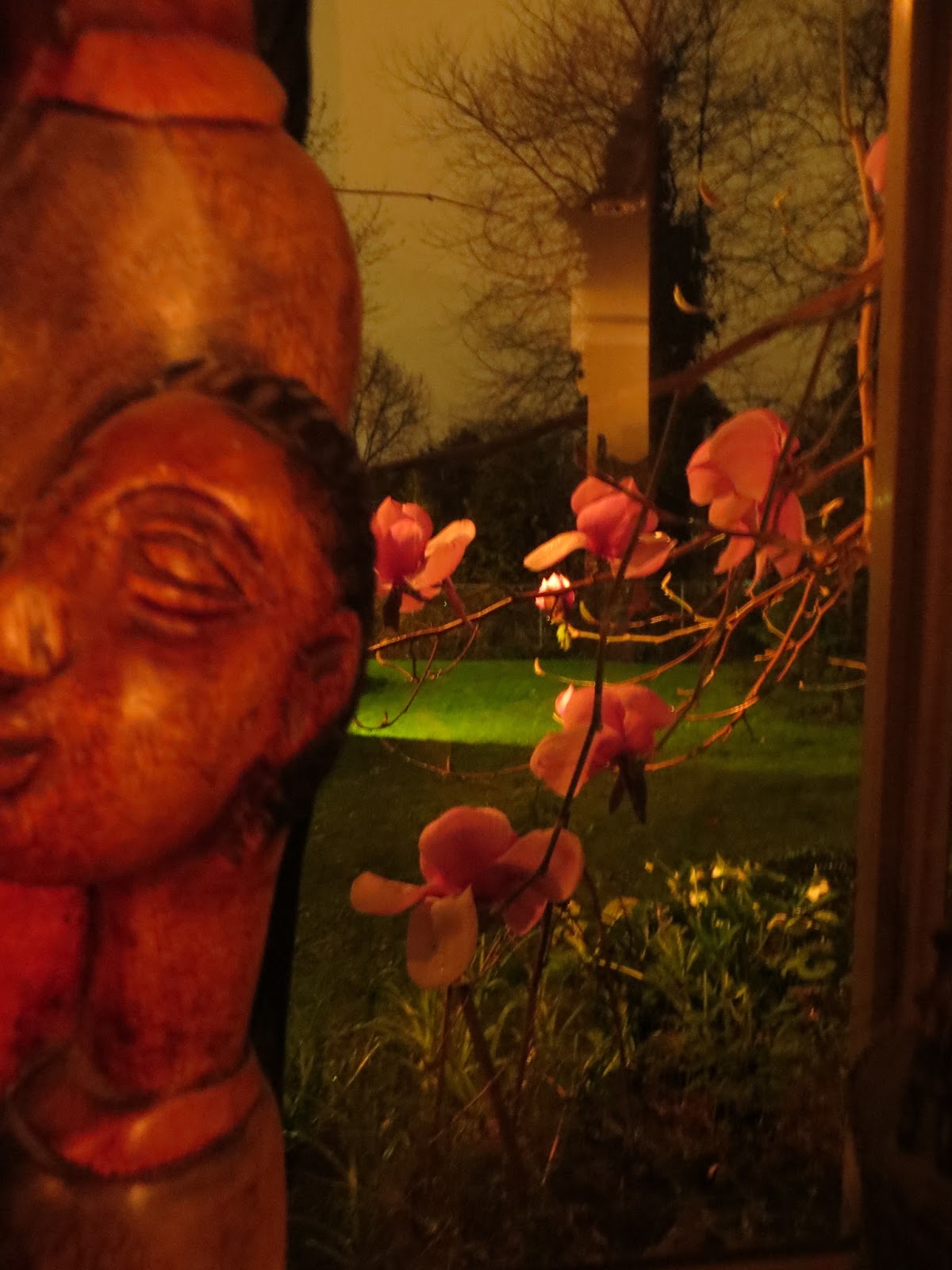
Monday, 4 January 2016

Grief: A Poem


I have been faced recently with grief and all the tangled emotions and thoughts that come with it. The poem below narrows in on one small aspect of the symphony.


Grief

pathetic in my grief
I find your hairs
linted up in hidden corners
rinse them off
set them awkwardly aside

there will never be another
I cannot throw them out


Photo and poem copyright Casey June Wolf 2016

Saturday, 14 November 2015

Dear Doctor McFadden...


I have wanted to write this letter for a long time. Indeed, I wrote a version of it, but I don't remember if I ever passed it to its intended. I think I was too embarrassed at the time.

Well, today I listened to CBC's White Coat, Black Art, and after a few minutes of interviews of comedians about their experiences with illness and the health care system, they suggested we write a letter to a doctor, or a patient (I notice they foolishly left out nurses, etc.) and then send it to, well, to the radio program. Which seems a bit indirect, but let's see where we go with this.

Approaching five years ago I received a cancer diagnosis which at first blush looked very scary and promised a substantial removal of flesh which would not regrow. But if I was lucky, I wouldn't die.

I had heard many good things about the BC Cancer Agency and expected treatment that was excellent, but I was cowed by the vastness of the place, the unfriendliness of some of the staff (no more, I suspect, than in any other large corporation), and the general on-your-own-ness of being there. Worse was the inability to make a human connection with my surgeon. I was hugely relieved when he was taken off the case. (They discuss each case as a group and decide who does what—a wise approach, I think. Far better than being stuck with the first specialist with a slot available and following whatever he or she thinks is best.)

Soon I met Dr. Andy McFadden, and everything began to change. He was emotionally available, funny, kind, as good a surgeon as the last fellow (better for my situation) but far superior in terms of helping me feel at ease. I don't recall if it was he who told me that the tumour was small enough that I had a pretty good chance of not being killed by it, but I do recall that he poohpoohed the previous doctor's ambitious plans for my flesh and said we could get away with a much more conservative excavation. (World tilts back on its original axis, almost.)

After the initial surgery, when he wanted to go back in to improve the margins (to my horror), I nervously agreed (better that than pop off too soon) and he said if I ever had any questions he was always available.

I believe I laughed. At that time, in that office (he works in several, as far as I can tell), there was a young receptionist who was impossible to get past. If I called and left a message, I never received answers. I took to bussing down to the hospital and sitting in the chair in front of her until she was forced to find out what I needed. (I sound awful. But how much more awful to have the whole thing unfold with no communication at all? And of course, I exaggerate. I think I did that once. Maybe twice.)

So when he said he was always available I exclaimed, "Great! Just tell me how to get around your receptionist!" He blushed, and said something about this showing how overworked they are there. (Which I utterly believe.) He then made it possible for me to get directly in touch with him, bypassing her entirely.

Over the duration of our relationship, I used that option exactly twice. He immediately got back to me, said a quick, friendly hello, answered my question, and left me to sail (sort of) onward with much less anxiety.

So this is my letter:

Dear Dr. McFadden. Dear Andy.

I cannot tell you how dear you still are to me, having midwifed me through the worst time of my adult life. I have continued in cancer circles since then and have seen the alternative routes mine could have taken. I have tried to learn courage in all of this, knowing that like you, I can give much more to my friends and contacts when they are facing disease, loss, and death if I can sit through my own fear and hang onto my connection with them as real and living human beings. (That's the key, isn't it? You treat us as living, not as sick.)


I never felt like you viewed me as a "case", though you were diligent and precise in your thought about the cancer. You were always warm, always kept your sense of humour, didn't waste time but never hurried me, either. You asked me about the books I was reading, shared thoughts about important things in our lives that had nothing to do with cancer, and made yourself available to help stave off the terror that was eating away at me more voraciously than the cancer.


Now that I am writing, this seems like all the letters written by all the people who ever were in trouble and received help. I have no grand insight to offer and no amazing way to frame it. It's just deep, enduring gratitude and love for the great humanity you brought along with your awesome skill.


You look very sweet in scrubs, by the way. That helped, too.


Love, and hopes for the very best that life can give you. Oh, and these flowers are for you.


Till we meet again.


Casey


(Watch Andy pitch the Top to Bottom campaign for Colon Cancer Canada.)

Monday, 19 October 2015

“Poem Beside Your Hospital Bed”


This poem knocked me over when I read it in Real Cool: poems to grow up with, a wonderful anthology of Irish and international poetry edited by Niall MacMonagle*. "Poem Beside Your Hospital Bed" is simple, vast, and aims straight for the heart.

A week or so after discovering it I found it still on my mind. I phoned a friend who shares my love of good writing and read it to her without rereading it first. I had remembered I loved it; I had forgotten its content. One stanza in we were both in tears.

Thank you, Michael O'Dea, for articulating what we know so well, but couldn't say.


Dad


Poem Beside Your Hospital Bed                

Your face,
that I loved,
has changed so completely
that I already know
our time is gone.

And as dying
like a sandstorm,
rearranges your features,
I am useless,
a cripple of words.

So if the winds in your head
will carry the smallest breath
of what I am saying, father:
let it be that
my proud years are tatters here;
I love you.


* I was looking for a C.V. or something to tell you a little about the editor. These student evaluations are much better than that could be.
Follow the link on Michael O'Dea's name to visit his blog, Poetry and Miscellaneous Yap, which features a "world of Irish poetry and Irish poets, literature, politics, nature, mythology, archaeology, tourism, art, love and war, and whatever else comes to mind on any particular day". The link on the poem's name takes you to his posting of the same, with an introduction.

Tuesday, 13 October 2015

Joyous Compromise


photo by Casey June Wolf


...there waits the joyous compromise through art with all that wounded or defeated us in daily life...

                                          Justine: a Novel.
                              Lawrence Durrell
  
photo by Casey June Wolf


Friday, 25 September 2015

Audience of One (For Bob, Who Wanted to Know How It Worked)


Not actually Brigit OR Mary, but St Lucy wearing a harrow crown


Audience Of One

I belong to a weekly writers workshop that meets through the cooler months, making of a little more than half the year a time that has been for me, for a few years now, focussed on writing poetry to, about, and in honour of Brigit, both as goddess and as saint, in her (their) many, often conflicting, aspects and time periods. This season has just recommenced and much as I’ve enjoyed the summer writing—a longish research paper, some short essays, and portions of an online course—I’m comforted and delighted to be back with the poetic source that I can’t seem to stem.

By which I mean, the number of poems continues to grow. Each fall I say, Yes! Now I will finish editing these Brigit poems and get on to the next project. But the more I edit, the more I am inspired to write. The more I write, the more I refer to materials to be sure I’ve got things straight. And the more I refer to these materials, the more wonders I encounter, flushing up the desire to write (oh, guilty pleasure) yet another poem... Maybe what I am learning from this is that I shouldn’t worry about “finishing”, that though a collection may yet come of it, for me the practice of writing these poems is the most important thing.

Last week, after our first meeting, a new member of the group asked if he could pose a few questions about the process I go through when writing the poems. He offered to pay me for my time by buying me a cup of coffee. (He is much cheaper than you may imagine. Our coffee goes for fifty cents per class.) I agreed, and this is the result. (He may have bitten off more than he can chew. Sorry, Bob.)


Wednesday, 23 September 2015

“Winter on the Plain of Ghosts” by Eileen Kernaghan


A few years ago I read the one and only self-published novel by award-winning writer (Sounds great, doesn't it? Well, it's true. But that doesn't necessarily mean you will ever have heard of her), Eileen Kernaghan.

Winter on the Plain of Ghosts: a Novel of Mohenjo-Daro. The book is set in the Indus Valley, so long ago that all we know of the culture that existed there is what we can divine from a set of clay seals (pictured above and below). Kernaghan does a wonderful job of filling in the world and peopling it with compelling characters.

I have no idea why, of all her lyrical and thoughtful adult and young adult novels, this one failed to find a publisher. After ten years of bouncing it around Kernaghan caved in to her husband's nagging and put it out herself under the imprint Flying Monkey Press.

I am so glad he did keep bugging her. Left to her own devices, would she have thought it was just a lousy novel and gone on to the next beautiful gem? I don't know. What I do know is that I had (for me) a rare experience when reading this book: that of spending the day, while off doing other things, thinking with great pleasure about the writing—the words themselves and the places they were taking me—and anticipating somewhat impatiently when I would get to be home again with feet up and Winter on the Plain of Ghosts on my lap.

It has stayed with me as a precious read, but a faded memory, one I don't pull out too often. Recently I glanced at the book again and read the poem that opens it, a poem that is collected with her other delicious speculative offerings in Tales from the Holograph Woods. It reminded me of how much I'd enjoyed the book, and how annoyed I am that so few people have had the chance to enjoy it as I have. So I thought I would introduce you to it and urge you, if you like what you see, to get a copy, read it, pass it around, and let the world know how much you enjoy this novel and this inestimable writer's work.


Mohenjo-daro

The salt earth is bleached
and brittle as old bone, in winter
on the plain of ghosts.
Shrill and thin down the grey
millennia, the spirit voices
cry on the parched wind.
Language of a dead land―
the wind’s riddles:
insistent and insinuating
whisper of pale grasses,
tongueless as corpses the slow
suck and hiss
of the river’s mouths
and age-deep in the dust
of empty water-courses
the cryptic dialect
of broken stones.

But on the terraces below the citadel
a flute plays
and ghosts rise in their shining bones
bedecked with jade and lapis lazuli.
Above the luminous pools white birds drift
long-stemmed as water lilies
and terrible in their stripes
behind the broken walls the tigers walk
among the glamorous trees.


This gives you a sense of Eileen Kernaghan's wordcraft and imagination. But let's give you a little of the novel itself. I shall indulge myself by adding a fair dollop of it below. Before we go, I'll add these links, and then leave you in Ms. Kernaghan's capable hands.

To read the review on the Historical Novel Society website, click here.
To order either the print edition or the e-book of Winter on the Plain of Ghosts, click here.
To order Tales from the Holograph Woods, click here.


Winter on the Plain of Ghosts:
A Novel of Mohenjo-Daro

PROLOGUE
            this morning, when I visited the warehouse, Akalla was breaking the seal on a chest full of luxury goods — among them some jars of unguent imported from the western deserts of Meluhha. I took one home with me and opened it in the privacy of my bedchamber. Released from its stone container, the rich, oily perfume awoke a rush of memories.
            Once again I breathed the fragrance of oleander, growing high up in a desolate hill pass. I heard the throbbing of the skin drums, the wistful music of the reed-pipes; and the shrill voice of the desert wind, crying across the parched, dun-coloured plain. But underneath the scent of spice and sun and flowers there was a hint of something darker, muskier — a cloying, sweet-sour odour of the swamp. And there rose in my mind's eye a vision of the great Meluhhan capitals, those once noble cities of the plains. I saw them crouched behind their crumbling walls like enormous stricken animals, choking on their own poisoned breath.
            Already it is the month of Nisan. The floodwaters are rising, and another year is almost over. I have lived long; have, I believed, sinned no worse than other men; have suffered much, and have received many blessings from the gods. It is, at this moment, as though I am standing on a high terrace, from which it is possible to look down upon my life's beginning, and on its end.
            And so, in this city of Ur, in the reign of the great king Rim-Sin of Larsa, I, the merchant-captain Rujik, set down my history — having instructed my storekeeper to lay in a great quantity of clay.

Friday, 11 September 2015

“Villette” by Charlotte Brontë


I thought that I was safe. Working quietly away in my little room, walking my cat and doing yoga in the yard, tending my community garden plot and visiting, when the moment made itself available, with friends and family.

I did not expect to have my heart broken again.

The last while, in between all those other noble ventures, I have been reading Charlotte Brontë's Villette, a well developed tome with none of the histrionics of, say, Jane Eyre. In turns I was blown away by the writing, irritated by the anti-Catholic diatribes, entranced by the world and annoyed with the protagonist.

Nothing bugs me more than spoilers, so I will be very cagey here. Suffice it to say that this book was to many of the books I piddle my time away on what meatloaf is to potato chips. It fed me, it awakened me, and it broke my heart. I can't think how many times tears have come to my eyes in the day since reading the book. I'll say no more, except, if you have the strength, read it.

“I believe in some blending of hope and sunshine sweetening the worst lots. I believe that this life is not all; neither the beginning nor the end. I believe while I tremble; I trust while I weep.”